Grew Up on Set, Blew Up in the Tabloids: The Uncanny Curse That Follows Childhood Co-Stars Into Adulthood
Picture this: two kids, maybe eight and ten years old, thrown together on a studio lot in Burbank or Vancouver or Atlanta. They spend more waking hours together than with their own families. They share a dialect coach, a tutor, a craft services cart, and — crucially — the pressure of performing for millions of people while their brains are still literally developing. The show runs for years. The friendship (or rivalry, or complicated in-between thing) deepens into something that has no real-world equivalent.
And then the show ends. And then, almost inevitably, the tabloids begin.
The childhood co-star curse isn't a superstition. It's a pattern — one that stretches across decades of Hollywood history and keeps repeating itself with an almost eerie consistency. We're not talking about one or two unlucky pairings. We're talking about a documented, traceable phenomenon that has produced some of the messiest celebrity stories of the last 30 years.
The Hothouse Effect
To understand why former child co-stars so frequently end up in dramatic headlines together, you have to understand what the production environment actually does to kids.
Child actors don't just work together — they bond in a pressure cooker. They navigate the same bizarre reality: being famous before they're old enough to vote, having parents who may or may not have their best interests at heart, working 12-hour days under professional obligations most adults would find exhausting, and doing all of it while trying to figure out who they actually are as human beings. The relationships that form in that environment are intense in a way that's almost impossible to replicate later in life.
"The friendships — and the tensions — that develop on a long-running kids' show are unlike anything else in the industry," says one former child actor who appeared on a prominent early-2000s network series and has since transitioned to producing. "You're not just colleagues. You're not quite family. You're something in between, and there's no real template for what that relationship is supposed to look like once the show is over."
When the cameras stop rolling, those bonds don't dissolve — they just stop having a structured container. And that's when things get interesting. Or, depending on your perspective, chaotic.
The Receipts Are Everywhere
Let's run through the pattern, because the examples are genuinely staggering once you start cataloguing them.
The cast of Saved by the Bell has spent three decades producing more memoir-worthy drama than most soap operas. Dustin Diamond — who played Screech — spent years feuding publicly with his former co-stars, wrote a tell-all book that his castmates called fabricated, and was ultimately convicted of a stabbing charge in 2015 before his death in 2021. The remaining cast members, by most accounts, did not exactly mourn the book.
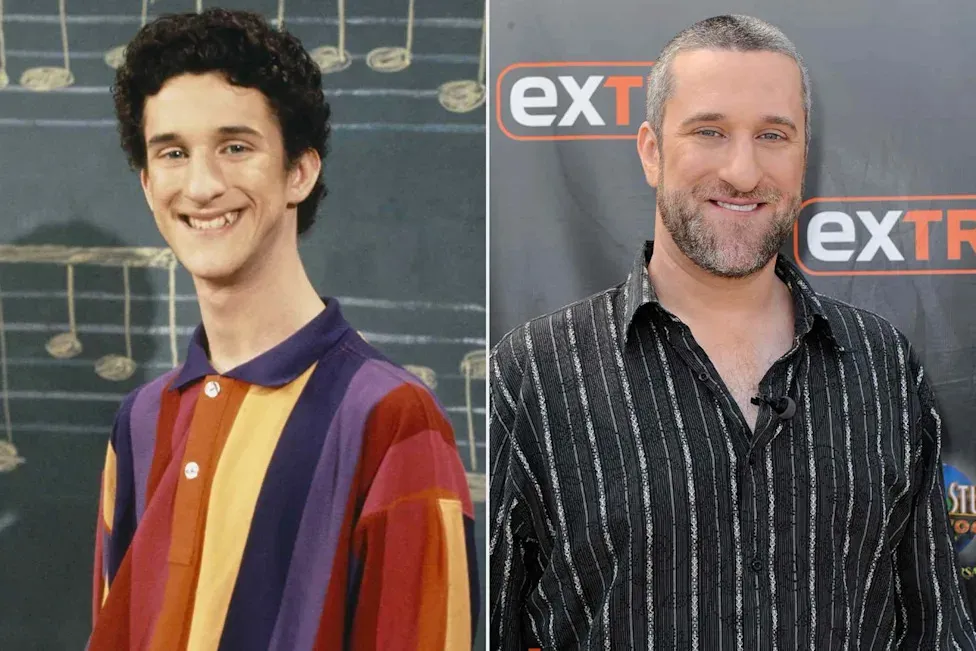 Photo: Dustin Diamond, via s.yimg.com
The Nickelodeon extended universe — if we can call it that — has been a particularly reliable tabloid generator. The allegations that emerged from former child stars about conditions on various Dan Schneider-produced shows (chronicled extensively by outlets including The Hollywood Reporter and Business Insider, and eventually explored in the Peacock docuseries Quiet on Set) reframed years of co-star tensions and public falling-outs in deeply troubling new context. What had looked like ordinary celebrity drama started to look like the predictable fallout of genuinely harmful working conditions.
Over on the Disney side, the High School Musical extended family has had its own tabloid moments — though generally less dark than the Nickelodeon canon. Vanessa Hudgens and Zac Efron dated for years after filming, broke up, and both went on to very different career trajectories that the internet has never quite stopped comparing. The cast of Wizards of Waverly Place has remained mostly drama-adjacent, though Selena Gomez's complicated years in the spotlight — the health struggles, the high-profile relationship with Justin Bieber, the media scrutiny — have always carried the shadow of a childhood spent under intense public observation.
 Photo: Selena Gomez, via www.hola.com
 Photo: Vanessa Hudgens, via www.okchicas.com
And then there's the Stranger Things generation, which is still young enough that we're arguably watching the first chapter of whatever comes next. The cast members have already navigated public relationships, intense fan shipping culture, and the particular pressure of being teenagers whose every interaction is documented and theorized about online. The tabloid chapter, if the pattern holds, may still be ahead of them.
Why the Falling-Out Almost Always Happens
There are a few structural reasons why childhood co-stars tend to collide in adulthood.
First, there's the career divergence problem. When one former co-star becomes significantly more successful than another, the imbalance can create resentment — particularly when the less successful party feels their shared history is being rewritten or minimized. The more famous person moves on; the less famous person is still defined by the project they did together. That asymmetry has a way of festering.
Second, there's the shared secret problem. People who grew up together on set know things about each other — and about the production — that the public doesn't. When relationships sour, those secrets become leverage. This is why former co-star feuds so often involve very specific, very detailed allegations rather than vague bad blood. They were there. They saw things.
Third — and this is the one that doesn't get discussed enough — there's the arrested development problem. Child stars who become famous young often struggle to develop the emotional tools that most people build through ordinary adolescence. When two people with those same developmental gaps end up in conflict as adults, the results can be spectacularly unregulated.
What the Internet Does With All of This
Modern celebrity fandom has added a whole new dimension to the co-star curse. Fan communities spend years constructing elaborate theories about the relationships between cast members — who's secretly in love with whom, who had a falling-out in season three, who was the real villain of the group chat. When actual drama surfaces, it lands in an ecosystem that's already been primed to receive it.
The Quiet on Set docuseries is a good example of this dynamic. Former Nickelodeon fans who had spent years in online communities dissecting the interpersonal dynamics of their favorite shows suddenly had documented context for things that had always seemed slightly off. The reaction was enormous — not just shock, but a kind of grim recognition.
The Curse Isn't Going Anywhere
Hollywood continues to cast children in major productions. The pressures that create the hothouse environment haven't meaningfully changed. And the tabloid apparatus that profits from the fallout is more robust than ever.
If anything, the social media era has shortened the timeline. Where it used to take a decade for the drama to surface, former child co-stars can now air their grievances in real time, in public, with screenshots.
The show may be over. But the story? The story is always just getting started.
Somewhere right now, two child actors are sharing a laugh on a studio lot — and a tabloid editor is already clearing space on the front page for whatever comes next.