The RSVP Was a Lie: Inside Hollywood's Open Secret of Celebrity No-Shows Who Technically Still 'Appeared'
The RSVP Was a Lie: Inside Hollywood's Open Secret of Celebrity No-Shows Who Technically Still 'Appeared'
Here is something nobody in Hollywood will say on the record, but virtually everyone in the industry knows: that celebrity you saw on the red carpet last month? The one whose arrival photos circulated everywhere, whose outfit got dissected on every fashion blog, who was listed in every 'who attended' roundup? There is a non-trivial chance they were somewhere else entirely when those photos were taken. And the event organizers know it. And they are not happy about it.
Welcome to the Stand-In Red Carpet Strategy — the open secret that's reshaping how Hollywood manages appearances, and what it quietly reveals about the increasingly exhausting performance of being famous in 2025.
The Anatomy of a Fake Appearance
The mechanics of this are more sophisticated than they sound, which is probably why it's taken this long for the practice to get serious attention. It doesn't work the way you might imagine — there's no celebrity lookalike in a full disguise waving at fans. The reality is both more mundane and more calculated.
Here's a version of how it typically goes, according to multiple sources familiar with event production and celebrity talent management: A celebrity confirms attendance at a high-profile event — a film premiere, a charity gala, an award show after-party. Their team coordinates with the event's publicist. Their stylist begins pulling looks. The RSVP is official, the name goes on the press list, and the event's marketing team starts quietly including the celebrity in their promotional materials. Then, somewhere between two weeks and forty-eight hours before the event, something changes. Maybe it's a scheduling conflict. Maybe it's anxiety. Maybe it's a contractual obligation that requires a presence but doesn't specify what kind of presence. Maybe the celebrity simply doesn't want to go and their team is trying to find a middle path.
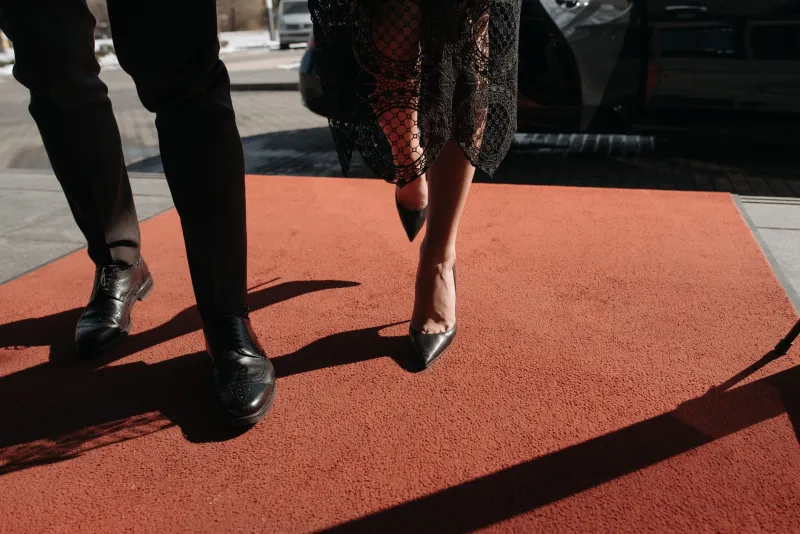
What happens next depends on the event, the celebrity's leverage, and how creative their team is feeling. In some cases, a stylist or personal assistant handles the arrival — walking the carpet, being photographed in a coordinated look, doing enough of the visual work that the celebrity registers as 'present' in the coverage. In others, the celebrity arrives via a side entrance or private access point, completes whatever minimum contractual obligation requires their actual presence (a brief backstage appearance, a handshake with a sponsor), and then leaves before the public arrival sequence begins. The carpet photos, taken of whoever walked it, do the rest of the work.
Why This Is Happening More Than You Think
The reasons behind this practice are genuinely varied, and not all of them are cynical. Security concerns are real and escalating — the logistics of moving a high-profile celebrity through a public red carpet have become increasingly complex, and for some talent, the anxiety associated with large public gatherings is legitimate and documented. Sources close to several A-list clients describe a post-pandemic recalibration of public appearance tolerance that has simply never fully reversed.
There's also the contractual dimension, which entertainment attorneys describe as the primary driver of the more strategic versions of this practice. Many celebrity agreements with studios, brands, and event sponsors require 'attendance' at promotional events — but the definition of attendance in those contracts is often surprisingly vague. 'Presence at the venue' is a common formulation. What constitutes presence, and for how long, and in what capacity, is frequently left to interpretation. Teams with good lawyers have gotten very good at interpreting it in their client's favor.
And then there's the simple, unglamorous reality that being a celebrity at a major event is a significant amount of work. The prep time, the styling sessions, the security briefings, the required interactions with sponsors, the press line obligations — a single major red carpet appearance can consume an entire day and a considerable amount of emotional bandwidth. When you're doing several of these a month, the appeal of a strategic shortcut becomes easy to understand, even if the execution is ethically murky.
The Event Organizers Are Quietly Furious
Here's who is not finding any of this understandable: the people who sold tickets, secured sponsors, and built their event marketing around a celebrity's confirmed attendance.
Several event production professionals, speaking anonymously to entertainment trade publications, describe the practice as an increasingly common source of backstage tension. The damage isn't just logistical — it's financial. Sponsors pay premiums for events that can guarantee specific talent will be present and visible. Ticket buyers, particularly for charity galas, are often making purchase decisions based partly on who's confirmed to attend. When the celebrity doesn't show — or shows in a form that doesn't deliver the expected visibility — the ripple effects hit everyone downstream.
'There's an unspoken rule that you don't call it out publicly,' one event producer told a trade publication, 'because you want to work with these people again. But everyone knows it happens. And everyone resents it.'
The 'you want to work with these people again' calculation is the key to why this practice has persisted without becoming a public scandal. The power dynamics of the celebrity event ecosystem strongly favor the talent. Event organizers, sponsors, and venues need the names more than the names need them — which means grievances tend to get swallowed rather than aired.
The Performative Exhaustion of Modern Fame
Zoom out from the logistics for a second and the bigger picture is genuinely interesting. The Stand-In Red Carpet Strategy is, at its core, a symptom of a celebrity culture that has become so demanding — so relentlessly 'on' — that even the people who chose this life are finding ways to send a representative instead of showing up themselves.
There's a certain poetic irony in the fact that the red carpet — the most theatrical, most carefully staged, most explicitly performative ritual in all of celebrity culture — is the place where some celebrities have decided the performance is simply too much. The velvet rope was always theater. Now even the actors are hiring understudies.
What makes this moment distinct from previous eras of celebrity management is the scale of the expectation. The modern celebrity isn't just expected to attend events — they're expected to be fully present, visually compelling, socially engaging, and content-ready at all times. Every appearance is a content opportunity. Every red carpet is a multi-platform moment. The appetite for celebrity visibility has grown faster than any human being's capacity to supply it, and the Stand-In Strategy is, in a very real sense, the celebrity industrial complex eating itself.
What to Watch For
Expect this conversation to get louder as award season ramps up and event organizers start quietly comparing notes. Watch for updated language in celebrity appearance contracts — entertainment lawyers are already reportedly working on tighter 'presence' definitions that close the loopholes currently being exploited. And keep an eye on the carpet arrivals that feel slightly off — the ones where the coverage is somehow everywhere but the celebrity seems to evaporate immediately after.
Somebody walked that carpet. Whether it was the person on the invitation is, increasingly, a question worth asking.
The RSVP said yes — but in Hollywood, yes has always had a surprisingly flexible definition.